
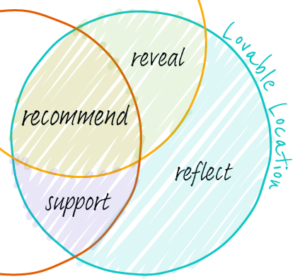
In an earlier article, I introduced you to the DMO Venn Diagram. In this one, we’ll begin applying it to your situation through a series of exercises that address the Lovable Location corner of the chart.
Try not to take the exercises especially seriously… their purpose is to give you a better grasp on the concepts, and to prompt you to ask yourself interesting questions about your work.
The exercises will ask you to use your subjective judgment to separate and filter ideas into sets. At every turn, you will find this challenging because, ultimately, reality is resistant to neat categorization. Ideas may fit better along a spectrum between one thing and another, or they may be both things at the same time. How you handle this is up to you, and the ambiguities can be quite revealing. I encourage you not to overthink any of it and just have fun.
Exercise 1: Itemize the lovable
Just as when we looked at the entire diagram, I think it’s best to begin by enumerating all that is lovable about wherever it is you are marketing. This is a deliberately broad and uplifting exercise. Consider…
everything that makes it special to live in, anything both unique and cool, its je ne sais quoi, those elements one hopes will endure.
Items can be concrete or abstract. Try not to censor or pre-filter whatever bubbles up at this point, and, if time allows, poll as diverse a group as you can muster. Our backgrounds and situations color our experiences of place as much as anything else, and you will likely be surprised by what others find appealing. Transplants will have different perceptions from those that grew up there, parents from non-parents, backpackers from business people, wheelchair users from pedestrians.
The only rule is to hold tight to the concept of lovability as earlier defined. Do not let this become an inventory of stuff that simply exists, and might therefore be lovable in the eyes of a less judgmental higher being. The exercise is necessarily subjective and discriminating – that’s not just OK, it’s the point. These are your personal 5-star picks.
Much that life has to offer is “mid”, 3-star quality and is absolutely fine. There’s nothing wrong with it per se. It just doesn’t belong in this list. What I’m saying is: leave Subway out.
If you like, write all of these things down on post-its.
All of this is an excellent start. Why? Because you’ve identified your differentiators. Destination marketing is awash with cliché. Everyone talks about their fabulous dining scene, and illustrates that message with a video of a chef plating a dish which is whisked away by a smiling waiter to be presented to a smiling couple in their early thirties without children, holding full wine glasses that reflect the golden sunset. Imagery both bland and nauseating – quite an accomplishment. You’re going to sidestep all that with your list!
Four kinds of lovable
So far we think we’ve itemized the elements that belong in this corner of our diagram:
Next we’ll want to determine their position more precisely… to which of these four sections do they belong?
This will be helpful, because it will tell us how to position them in our work… Should we be actively promoting them with ad spend, subtly nodding towards them in our photography, splashing them on the cover of our travel guide, or thoughtfully curating their listing among others on a page on our website, or some combination of the above?
All of the elements are lovable, but how ought we to love them, given our mission and limited resources?
To determine our attitude, we will attempt to sort our lovable elements into the four buckets (or intersections) contained within our Lovable Location circle: Support, Recommend, Reflect and Reveal.
Exercise 2: Fame
Step through your list of lovable things and, for each one, ask yourself if it is already a significant tourism draw that is at or near capacity. If so, it belongs in the support bucket. Such locations might need more help from you in terms of regulating traffic than in driving growth. You don’t need to market them, but you will feature them in your marketing because they are the genuine attractions that draw people to – and have a halo effect upon – the destination as a whole. You will advocate for their needs as drivers of the local economy, and you will work in partnership with them to create the best possible visitor experience.
Expect to debate the definition of capacity – does it lie where the visitor experience begins to diminish, or revenue has been maximized, or sustainability is compromised?
Exercise 3: Hidden gems
To determine whether a lovable element is a hidden gem, you need to assess the chances that a visitor would find it in the normal course of their research, or stumble upon it when they arrive.
If both seem unlikely, you have a hidden gem. This class of Lovable Locations belongs in the reveal bucket, because that’s the only way they’re going to be found.
I’ve made this sound easy, but objectively assessing a location’s discoverability is complicated. After all, there are an ever-increasing, ever-evolving number of channels through which you might discover something, and assessing the impact of each apropos the visiting public is impossible in full, expensive in part and largely futile where data is in short supply – which it most likely is for the kind of attraction you’re assessing here.
You will need to determine your own methodology, knowing whatever you choose will be controversial.
Perhaps you just walk in on Saturday afternoon and count the tourists.
For a slightly more sophisticated analysis, consider a location’s researchability and ambient discoverability.
In the pre-TikTok era, it was said that the three most important factors in retail success were “location, location and location.” To a lesser extent, this remains true today – if you have a downtown core, or even a main street or old town that affords foot traffic, and the location in question is situated there, then its environmental discoverability (one aspect of ambient discoverability) will likely be decently high. Likewise, if it’s adjacent to a major attraction or hotel.
Moving to the virtual world, locations that appear prominently in the results for common visitor searches have a high researchability. Since everyone eats, searches for “restaurants” on Google Maps and searches for “restaurants near me” or “restaurants in [city name]” in vanilla Google are all super popular… so if the location in question appears on the SERP (Search Engine Results Page) for those terms, it’s not a hidden gem.
If this exercise seems hard, it’s because it is. The boundary between the recommend and reveal zones is the fuzziest in the whole chart, and will be the subject of future posts. For now, try not to overthink it.
Exercise 4: Vibes
Less tangible than gems are vibes… Look down on Portland from a high vantage point and you mostly see trees. We have so many trees in such a high density that you can hardly see the bustling city beneath. While individual trees are certainly tangible, the sense of being in a forested urban environment is less so… it’s more of a “vibe”.
Similarly, places and their residents may deviate from the mean in terms of their personality. Perhaps your city is known for being laid-back and friendly. Perhaps nobody carries an umbrella despite the rain – which you find quirky and endearing, which is why it’s on your list.
Look through your list once again. Anything intangible, differentiating and of interest to visitors also belongs in the reveal bucket.
Exercise 5: Local news
There are probably plenty of things that are lovable about your location that visitors are not particularly interested in. The fact that you have excellent schools and all of the children are above average; the regular waste collection services and water treatment facilities; your amazing hospitals and libraries; the ease of obtaining a permit to build something. That’s not to say that these might not have an indirect effect on the visitor experience; just that they aren’t going to appear on the tourist map.
In this exercise, you’re going to loop through your remaining unsorted lovable location elements and decide whether they are mostly perks for residents. If they are, they belong in the reflect bucket.
As with all these exercises, items may be subject to debate. Bike paths are awesome, but most visitors in most destinations will not have access to a bike or want to ride one. There are, of course, plenty of exceptions. Like the Hiawatha Trail.
What Remains
Having progressively sifted out major attractions, hidden gems, local things for local people and intangibles, everything that remains belongs in the recommend zone.
If all has gone to plan, this will be a set of generalized terms for lovable things that you have and visitors want, for example “outdoor activities” and “annual events”, or specific examples of lovable things e.g. “hot springs” and “garlic festival” and “Momma Jane’s Pancake House” (you heard it here first).
In reality, there will be lots of debates to be had, because very few of the judgments these exercises call for are ever clear-cut. Perhaps the garlic festival is actually a hidden gem or a significant regional attraction or an exclusive black-tie dinner for the local garlic farmers association. Remember not to overthink the specifics, but reflect instead on the kind of thinking required to make the determinations, because doing so will help make all of the subsequent decisions less arbitrary.
Lovability and Tactics
In case a reminder is needed as to the point of all this, different kinds of tactics apply to lovable things depending on the zone into which they fall –
| Type of Lovable | DMO Tactics |
| Supportable | Stewardship, advocacy, cornerstone marketing. |
| Recommendable | Connecting visitors to best in class experiences through visitor centers, search optimized content, visitor guides, email marketing, social media channels, customer service training. |
| Revealable | Make discoverable through advertising, PR, wayfinding and visitor center staff (if they have the capacity to support growth). |
| Reflectable | Embody in destination brand. |
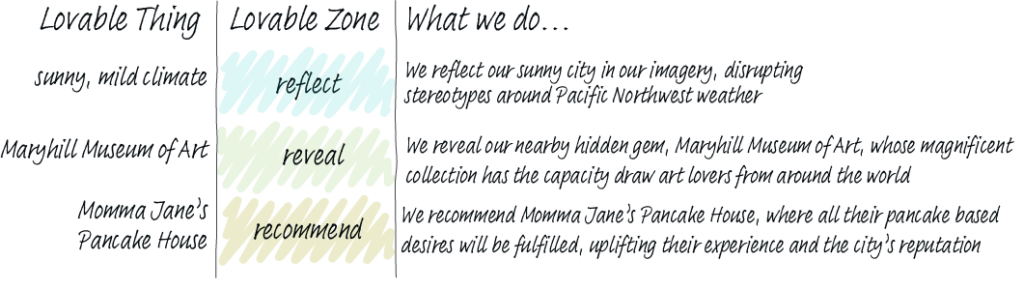
Sometimes an example helps. The following table lists three lovable things about The Dalles, Oregon, how they might be categorized in our Venn diagram, and the implications for the local DMO, should they agree.
Leave a Reply